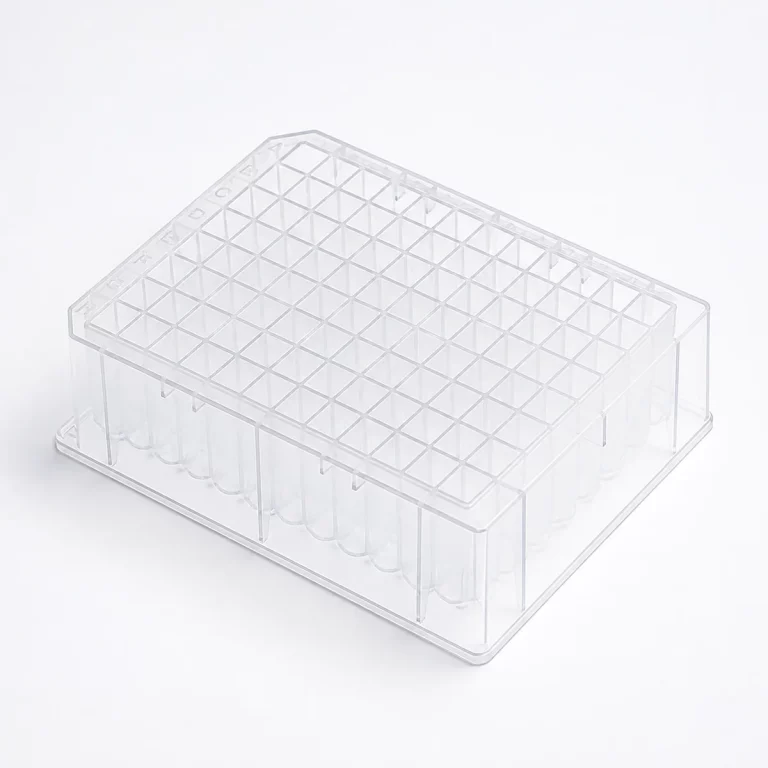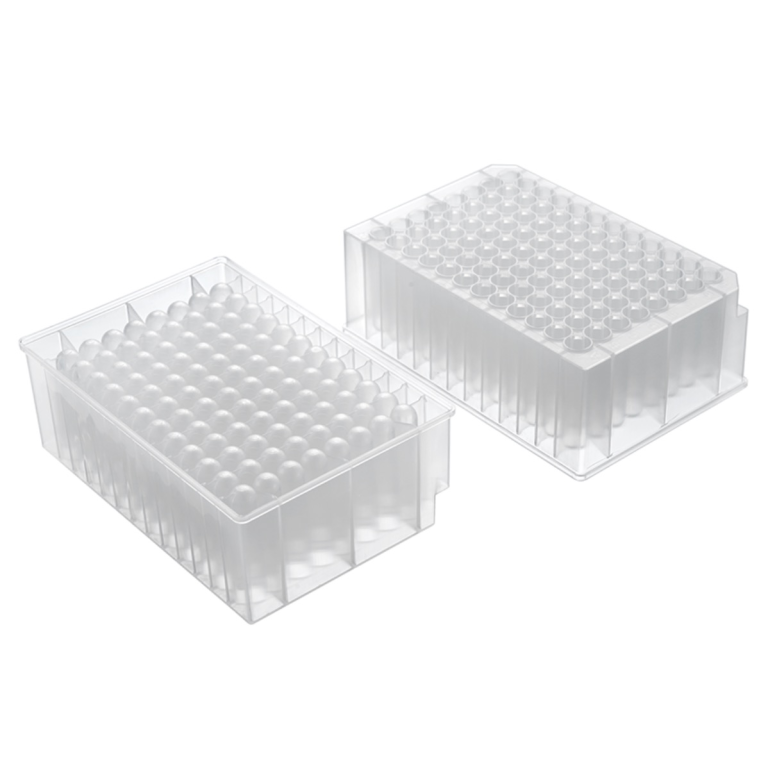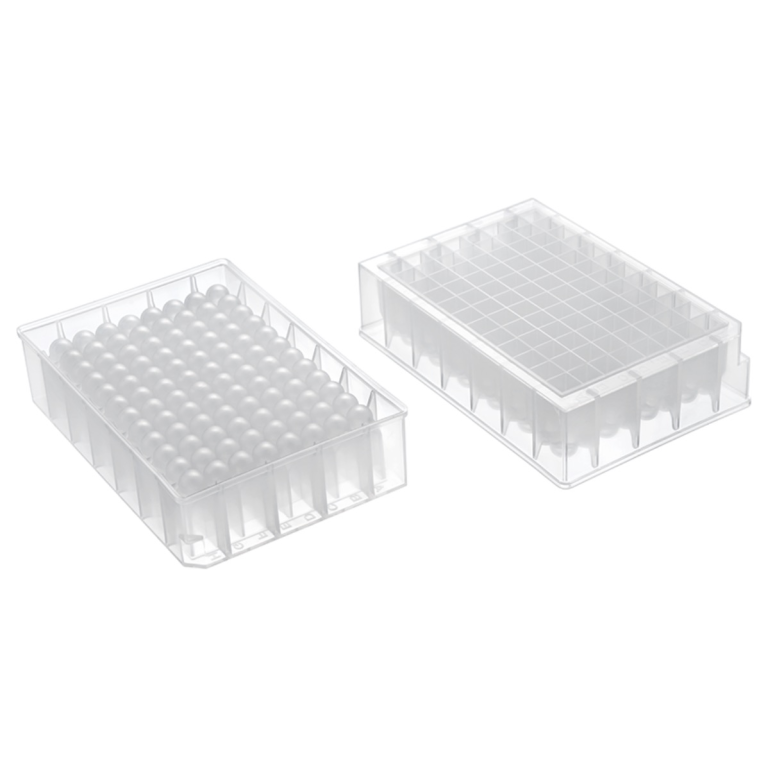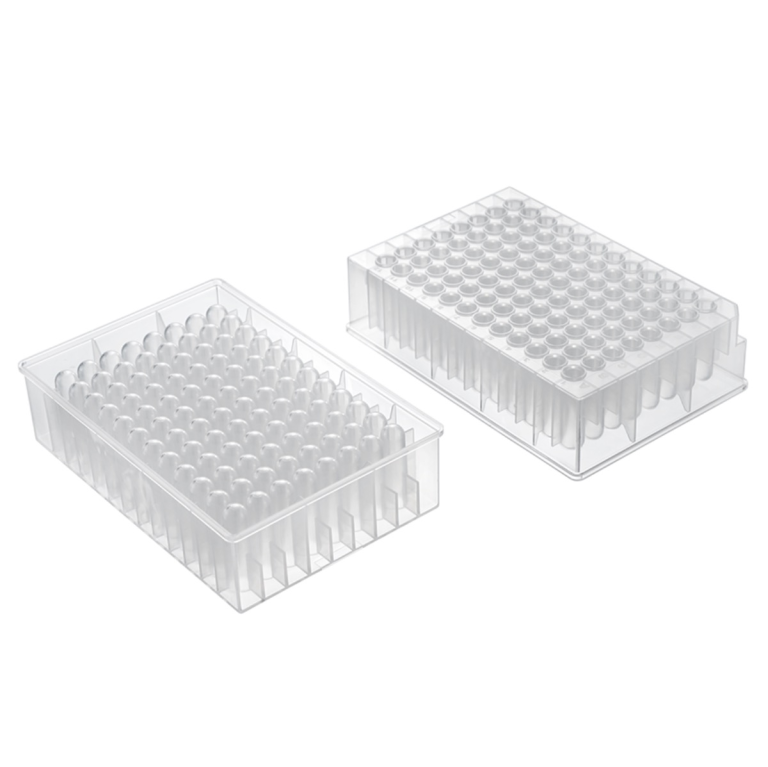

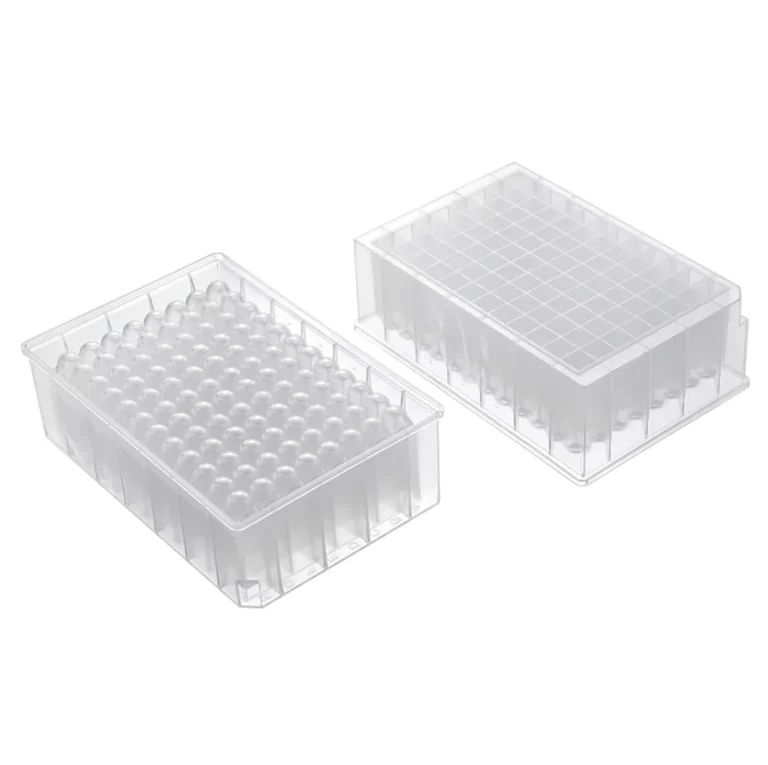

The Puretest 2.2 mL 96-well deep well plate family combines high per-well capacity with three selectable square-well structures: standard U bottom, profile-concave/I-shaped U bottom and conical V bottom. Buyers can compare the three geometries on one page and choose the plate that best fits storage, mixing, magnetic-bead processing and automated aspiration requirements.
The Puretest 2.2 mL 96-well deep well plate family combines high per-well capacity with three selectable square-well structures: standard U bottom, profile-concave/I-shaped U bottom and conical V bottom. Buyers can compare the three geometries on one page and choose the plate that best fits storage, mixing, magnetic-bead processing and automated aspiration requirements.
All three versions use a 96-well square array and 2.2 mL nominal capacity, but the lower well geometry changes liquid behavior. The standard U bottom offers a broad curved recovery area for mixing and storage. The profile-concave/I-shaped U-bottom version changes the external wall profile for specific carrier or structural requirements while retaining a rounded base. The V-bottom version directs liquid to a conical apex and is often selected for extraction and magnetic-particle workflows where low residual volume is important.
All three versions use a 96-well square array and 2.2 mL nominal capacity, but the lower well geometry changes liquid behavior. The standard U bottom offers a broad curved recovery area for mixing and storage. The profile-concave/I-shaped U-bottom version changes the external wall profile for specific carrier or structural requirements while retaining a rounded base. The V-bottom version directs liquid to a conical apex and is often selected for extraction and magnetic-particle workflows where low residual volume is important.
Do not treat the three structures as interchangeable in an automated method. Compare the technical drawings, plate height, side-wall profile, aspiration point, tip-comb clearance and carrier support. Validate a physical sample of the selected geometry before releasing a routine protocol.
| Plate format | 96 wells; 8 × 12 array |
|---|---|
| Nominal well capacity | 2.2 mL per well |
| Available structure 1 | Square well; standard U bottom |
| Available structure 2 | Square well; profile-concave / I-shaped wall profile; U bottom |
| Available structure 3 | Square well; conical V bottom |
| Material | Natural high-purity polypropylene (PP) |
| Surface | Non-treated |
| Footprint | ANSI/SLAS-style microplate footprint |
| Working-volume guidance | Below nominal capacity; V-bottom workflows may use lower aspiration volumes after validation |
| Sealing | Adhesive film, heat seal or square-well sealing mat; confirm selection |
| Sterility | Sterile and non-sterile supply options subject to quotation |
| Autoclave guidance | Selected configurations: 121°C for 20 minutes; confirm current SKU |
| Cleanliness | Applicable DNase/RNase and pyrogen status confirmed for the quoted SKU |
| Use | Single use; laboratory research and validated sample-processing workflows |
Values are nominal unless a tolerance is stated in the current Puretest drawing. Confirm dimensions, working-volume limits, packaging and applicable quality documentation before equipment validation or a production order.
| Application | Why This Format Is Suitable |
|---|---|
| Magnetic-bead sample processing | V-bottom geometry concentrates liquid near the aspiration point; validate the tip comb and magnet system. |
| High-volume sample storage | U-bottom options provide useful capacity and broad recovery surfaces. |
| Mixing and resuspension | Standard U bottoms favor smooth circulation and pellet resuspension. |
| Instrument-specific carriers | Profile-concave/I-shaped construction can suit selected deck or support geometries after drawing review. |
| Nucleic-acid extraction | Processes lysis, binding, washing and elution intermediates in parallel. |
| Mother-plate and compound workflows | High capacity supplies downstream plates and assays from a 96-position source. |
The plate is manufactured from natural high-purity polypropylene selected for chemical resistance, low biomolecule binding and reliable molding consistency. Available cleanliness and supply configurations should be defined in the quotation. Puretest can confirm the applicable DNase/RNase, pyrogen, sterility and lot-document status for the selected catalog configuration.
If your workflow requires a Certificate of Analysis, Certificate of Conformance, irradiation record, dimensional report, extractables information or a specific contaminant limit, state the requirement before ordering. This ensures that the quoted SKU and batch documentation match your laboratory or regulated purchasing specification.
The plate footprint is designed around common ANSI/SLAS microplate conventions for use with multichannel pipettes, plate handlers and automated liquid-handling platforms. Compatibility still depends on the instrument carrier, gripper, deck position, plate height, tip penetration and software settings; validate the current drawing and a physical sample before routine automation.
Puretest supports samples, technical drawings, sterile and non-sterile supply options, private labels, customer catalog numbers, barcodes, customized pouch and carton artwork, and distributor packaging programs. MOQ, case quantity, carton dimensions, lead time and international shipping method are confirmed with the selected configuration.
| Nominal Format | Well Geometry | Best-Fit Workflow |
|---|---|---|
| 200 µL elution | 96-well square V-bottom | Low-volume nucleic-acid elution and magnetic-bead workflows |
| 1.2 mL | 96-well round U-bottom | Resuspension, sample processing and compact storage |
| 1.6 mL | 96-well square U-bottom | Higher capacity in an automation-friendly footprint |
| 2.0 mL | 96-well round U-bottom | Mixing, recovery and general sample processing |
| 2.2 mL | 96-well U- and V-bottom options | Magnetic-bead processing, high-volume storage and extraction |
| 2.3 mL | 96-well square diamond bottom | Low-dead-volume mixing, automated extraction and high-volume sample processing |
| 4.6 mL | 48-well square U-bottom | Larger-volume culture, mixing and sample preparation |
Choose by required working volume, residual-volume target, mixing method, sealing method and instrument carrier. Request the current drawing before validating an automated protocol.
Choose standard U bottom for general storage and resuspension, profile-concave/I-shaped U bottom when a specific carrier or side-wall profile is required, and V bottom for concentrated aspiration and low-residual workflows.
No. Their bottom geometry and external profile can change carrier support, tip depth and aspiration settings. Validate the exact version with your instrument.
It is intended for common magnetic-particle and extraction workflows, but compatibility depends on the processor, tip comb, carrier and software. Request a sample and drawing for verification.
Many square-well formats use similar mats, but rim and penetration requirements can differ. Confirm the mat against the selected plate drawing.
Yes. State the instrument, process volume and residual-volume target so Puretest can arrange an appropriate comparison sample set.
Both supply modes can be discussed. Confirm the required cleanliness claims, packaging and documentation in the quotation.
Tell us the 2.2 mL configuration, intended instrument, working volume, sealing method, required cleanliness status, annual quantity and destination country. Contact Puretest for a sample, current technical drawing, quality-document confirmation or commercial quotation.
General Inquiries
Enquiry for: 2.2 mL 96-Well Deep Well Plate, U- and V-Bottom Options
Tell us what you need. You can ask for a quote, samples or help choosing a specification.

Hangzhou Puretest Biotech Co., Ltd. is an innovative company.
We use necessary cookies to run this website. With your permission, we also use analytics, Google Ads conversion measurement, and optional services such as live chat and embedded maps. You can reject optional cookies and still browse products or send an enquiry. Change your choices anytime in Cookie settings.
Tell us the product, specifications and quantity you need. We’ll reply by email with the next steps.