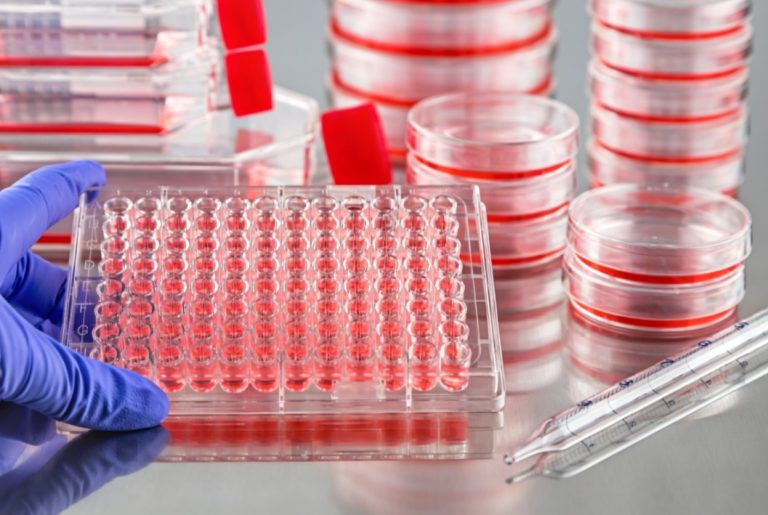

Selecting the correct laboratory vessel directly impacts experimental accuracy and reproducibility. In molecular biology and high-throughput screening, researchers frequently choose between PCR plates and standard microplates.
Although both are well plates, they are engineered for entirely different thermal and chemical environments. At Puretest—a premier global manufacturer of medical and laboratory consumables, including blood collection tubes, cell culture plates, deep well plates, and pipette tips—we specialize in ultra-pure molecular diagnostic products designed to optimize your laboratory workflows. This article clarifies the physical, material, and functional differences between these well plates to help you select the ideal option.
Understanding the Core Differences
PCR plates and microplates look much the same at first sight. Yet they differ in materials and physical traits that match particular lab tasks.
Material Selection and Thermal Conductivity
The polymer type sets how each plate handles heat and solvents.
- Thin-Walled Polypropylene: High-grade PCR plates come from medical-grade, ultra-pure polypropylene. This material has thin, even walls in each well. Heat passes through fast during quick thermal cycles.
- Polystyrene Options: Most standard microplates use polystyrene. It gives good clarity for readers. But it fails under high heat or sudden temperature changes.
- Chemical and Thermal Resistance: Polypropylene holds up above 100°C. Polystyrene wells often warp or break in strong heat. They do not work well for amplification work.
Well Geometry and Structural Configurations
Well shape plays a role in sample recovery, liquid handling, and how plates fit with automation.
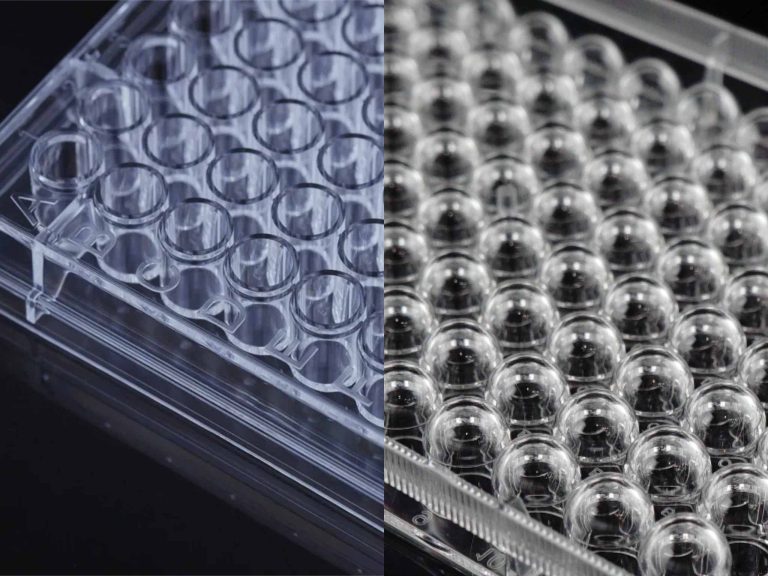
- V-Shaped and Conical Bottoms: Most 96-well PCR plates have conical or V-shaped wells. This design lets users recover all the sample even with small volumes from 10 µL to 200 µL.
- Flat and Round Bottoms: General microplates often show flat, U-shaped or V-shaped bottoms. These suit cell work, optical checks or mixing suspensions.
- Skirting Variations: PCR plates fall into non-skirted, semi-skirted and full-skirted types. The skirts give extra strength for robotic arms and thermal cycler blocks.

Operational Scenarios: Where and Why It Matters
Choosing the incorrect labware leads to sample evaporation, optical interference, or failed assays. Here is how each plate addresses specific experimental pain points:
High-Throughput Screening and Cell-Based Assays
For applications focused on drug discovery, cell growth, or protein interactions, requirements shift toward optical clarity and surface treatment compatibility:
- Colorimetric and Fluorometric Detection: Flat-bottomed microplates allow optical beams from readers to pass vertically through the sample with minimal refraction.
- Enzyme-Linked Immunosorbent Assays (ELISA): Polystyrene wells are often surface-treated to promote protein binding—a chemical property not natively supported by inert polypropylene PCR plates.
- Suspension Cell Cultures: Round-bottomed wells prevent cell clumping, ensuring uniform growth and consistent reagent exposure.
Quantitative Amplification and Genetic Analysis
In molecular diagnostics, managing micro-volume reactions without sample loss is a primary challenge. These specialized assays require precise vessel architectures to prevent physical and chemical failure:
- Real-Time PCR (qPCR): Standard assays rely on white or clear 96-well PCR plates to achieve maximum signal reflection and minimal background fluorescence.
- High-Throughput Sequencing (NGS): Library preparation processes utilize full-skirted PCR plates or 384-well PCR plates to remain flat and robust under automation and rapid thermal cycling.
- Thermal Contact Optimization: The thin-walled wells of a premium PCR plate ensure uniform heat distribution, reducing the “edge effect” where peripheral samples fail to amplify efficiently.

Technical Excellence: The Puretest PCR Plate Portfolio
At Puretest, we leverage advanced electric injection molding machines and automated MES manufacturing in our Class 100K GMP clean rooms to produce exceptionally consistent, certified DNase/RNase-free labware.
Puretest 0.1 mL PCR Plate, Semi-Skirted, FAST®-Type
This 0.1 mL PCR Plate, Semi-Skirted, FAST®-Type is optimized for high-speed qPCR systems and automated liquid handling:
- Low-Profile Design: Featuring a shorter well height, this plate minimizes dead space and reduces sample condensation, making it ideal for low-volume reactions.
- High-Contrast Alphanumeric Grid: Bold, black alphanumeric indexing makes well identification simple, reducing manual pipetting errors.
- Superior Sealing Protection: Elevated well ridges improve film adhesion, reducing evaporation rates to less than 5% during extended runs.
Puretest 40 uL 384-Well PCR Plate, ABI®-Type, One-Notch
This 40 uL 384-Well PCR Plate, ABI®-Type, One-Notch suits high-volume genomic work. Heat moves quickly and evenly across the 384 wells.
- Automation-Ready Rigidity: Its full skirt keeps the plate stable through hot cycles. Robotic arms handle it smoothly.
- Optimal Thermal Conductivity: It uses clear, pure polypropylene. Thin, even walls let heat pass fast and uniformly.
- Minimized Cross-Contamination: Raised edges keep samples apart. They seal tight with film or foil.

Data-Backed Performance
According to thermal performance studies, thin-walled polypropylene wells (measuring 0.15 mm to 0.2 mm) achieve thermal equilibrium within 0.1 to 0.2 seconds of cycler temperature changes. In contrast, standard-walled microplates experience heat-transfer delays of up to 1.5 seconds. This temperature lag can lead to non-specific amplification, primer-dimer formation, and decreased reaction efficiency.
Additionally, evaporation test data indicates that using a well plate with raised rims, such as the Puretest 96-well PCR plate, reduces sample volume loss from 12% to less than 3% when paired with professional adhesive sealing sheets. This preserves sample volume and maintains consistent salt and reactant concentrations across all wells.
Choosing the Right Well Plate for Your Lab
This chart gives a quick side-by-side view so you can match the right plate to your daily lab tasks.
| Feature / Metric | PCR Plate (e.g., Puretest 0.1 mL / 0.2 mL) | Microplate (Standard Assay Plate) |
| Primary Material | Medical-Grade Polypropylene (PP) | Polystyrene (PS) or Polycarbonate (PC) |
| Wall Thickness | Ultra-Thin (0.15 – 0.2 mm) for heat transfer | Thick-Walled (0.5 – 1.0 mm) for structural rigidity |
| Thermal Resistance | High (-80°C to 125°C); autoclavable | Moderate (-20°C to 80°C); warps under high heat |
| Well Bottom Shapes | Conical / V-Bottom for micro-volumes | Flat, Round (U), or V-Bottom |
| Typical Applications | qPCR, NGS Library Prep, End-point PCR | ELISA, Cell Culture, Absorbance Screening |
Streamline Your Lab Workflows with Puretest
A reliable supplier helps cut sample loss from evaporation during runs. It can also trim cycle times and deliver steadier results from one test to the next. Puretest supplies OEM and ODM services along with packaging that matches your needs. They manage shipping to many regions and assist with customs clearance.
Contact the Puretest team today to request free product samples or secure a custom wholesale quote!
FAQ
Q: Can I use a standard polystyrene microplate for running regular PCR cycles?
A: No. Polystyrene microplates fail under the high heat used in PCR. Denaturation runs between 95°C and 98°C. The material softens and can harm the blocks inside a thermal cycler. Switch to a polypropylene PCR plate for safety.
Q: What is the functional difference between non-skirted, semi-skirted, and full-skirted PCR plates?
A: Non-skirted plates work with most cyclers. They give little support once automation starts. Semi-skirted plates add moderate strength and space for labels. Full-skirted plates deliver the highest rigidity. Robotic liquid handlers run best with this type.
Q: Why do some PCR plates have white wells instead of clear wells?
A: White wells suit real-time PCR, also called qPCR. They reflect fluorescent signals upward to the detector. Light no longer passes through the sides. Background noise drops and detection becomes more sensitive.
Q: How do low-profile PCR plates improve experimental results compared to standard-profile plates?
A: Low-profile plates reduce the empty space above the liquid. A 0.1 mL well shows this clearly. Less air means less condensation on the upper walls. Reaction strength stays steady, and heat transfer works better.