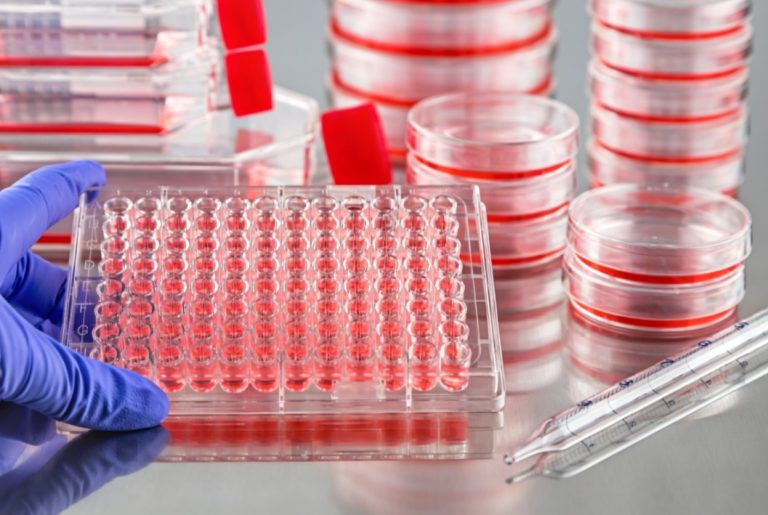
Cell culture plates come in a few standard formats:
– 6 well plates – Contains 6 wells designed for growing adherent cells. Each well has ~9.5 cm^2 surface area.
– 12 well plates – Contains 12 wells with ~3.5 cm^2 surface area per well.
– 24 well plates – 24 wells with ~1.9 cm^2 surface area per well.
– 48 well plates – 48 wells with ~1 cm^2 surface area per well.
– 96 well plates – Most common format with 96 small wells in an 8×12 grid. Each well has ~0.32 cm^2 surface area. Used for high-throughput applications.
– 384 well plates – Highest density plates with 384 ultra-small wells in a 16×24 grid. Wells have ~0.11 cm^2 surface area. Used when cell numbers are very limited.
– 6 well plates also come in low-attachment formats optimized for growing suspension cell cultures like blood cells.
The well size decreases as the number of wells increases, optimizing the plates for different cell yields and experiment types. Plates are made from polystyrene plastic for uniform cell attachment and growth. Some specialized plates may contain coatings or extracellular matrix proteins. But most standard cell culture plates have a uniform, untreated good surfaces.