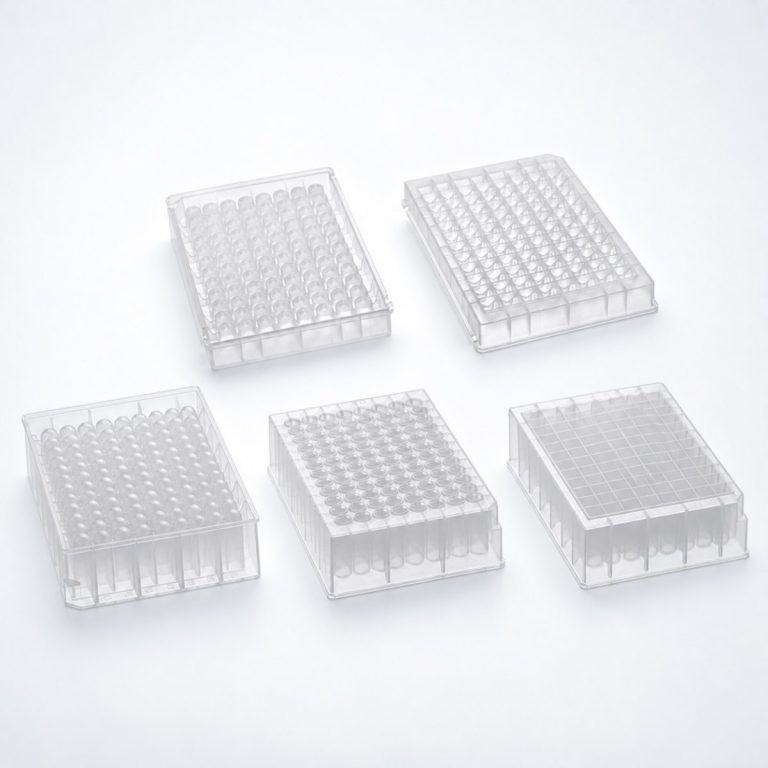
Here are some of the main types of well plates used in laboratory research:
– 96-well plates – The standard plate with 96 wells arranged in 8 rows by 12 columns. Well, the depth is typically 0.5ml. Used for high-throughput applications like ELISA, PCR, and cell-based assays.
– 384-well plates – Higher density plate with 384 wells, arranged in 16 rows by 24 columns. Wells are smaller and hold low volumes like 50-100μl. Allows running more replicates.
– Deep-well plates – Wells are deeper, with depths up to 2ml per well. Allow larger reaction volumes for applications like compound storage. Come in 96, 48, and 24 well formats.
– Low-volume plates – Wells optimized for working with small volumes, as low as 1-5μl. Help conserve expensive reagents.
– PCR plates – Designed specifically for PCR with ultra-thin walls for rapid heat transfer and cold storage. Come in 96 or 384-well formats.
– Cell culture plates – Available in 6, 12, 24, 48, and 96 well formats. Optimal for growing and analyzing cells.
– Assay plates – Specialty plates designed for specific assays like fluorescence or luminescence detection. May have flat, round, or conical well bottoms.
– Microfluidic plates – Wells have channels between them to perfuse fluids and create gradients. Used for cell culture assays.
The choice of plate depends on the type of application, sample volume, assay equipment, and throughput needs.