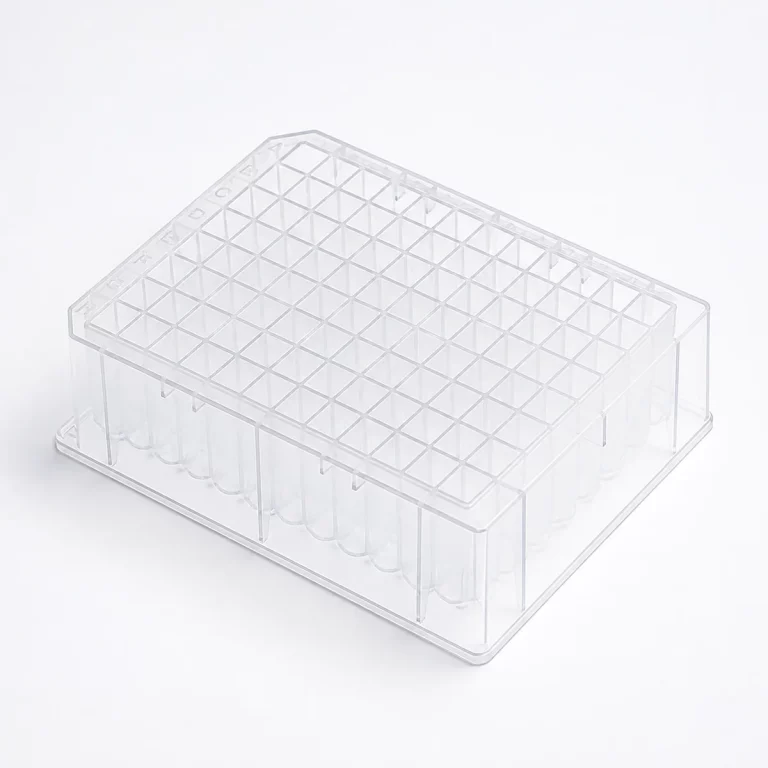

Sterile 96-well TC-treated polystyrene plate for high-throughput adherent-cell assays, screening, imaging and compatible reader workflows.
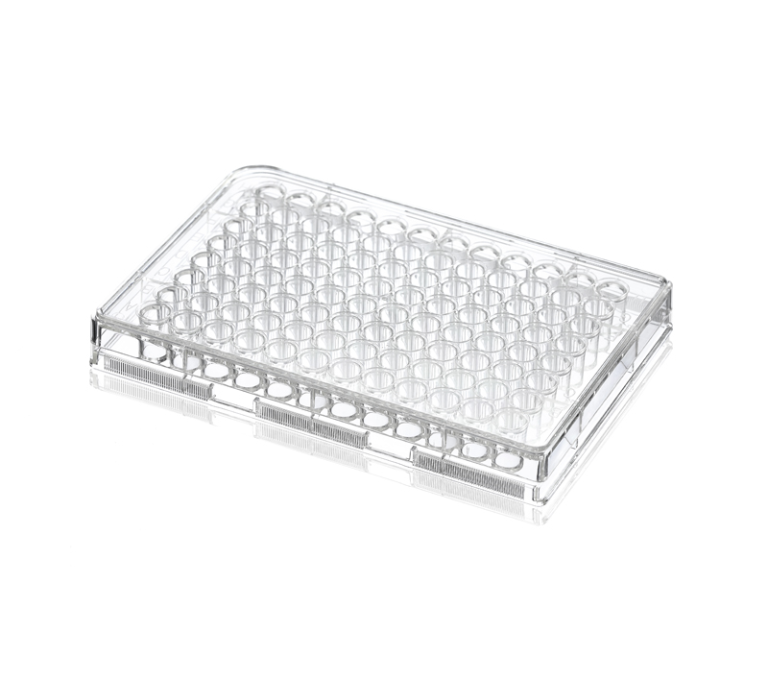
The Puretest 96-well TC-treated cell culture plate is designed for higher-throughput adherent-cell workflows that require efficient use of cells, media and test compounds. Each clear flat-bottom well provides approximately 0.32 cm2 of growth area, enabling 96 samples, controls or treatment conditions to be organized in a standard 8 x 12 format.
The high-clarity polystyrene plate combines a uniform tissue-culture-treated surface, alphanumeric well identification and a matching lid. It is suitable for cell viability and cytotoxicity assays, drug screening, transfection studies, microscopy, image-based analysis and compatible plate-reader workflows. Each plate is gamma-irradiation sterilized and individually packaged.
The plate uses 96 individually separated wells arranged in an 8 x 12 matrix. Each well has an approximate diameter of 6.77 mm and an approximate growth area of 0.32 cm2. A recommended working range of approximately 70-200 µL per well supports cell-based assays while conserving media and treatment compounds. The optimum volume depends on cell type, incubation time, evaporation control and assay-detection method.
The plate measures approximately 127.39 x 85.30 x 14.36 mm and follows an approximately standard microplate footprint. Clear flat bottoms support routine observation and compatible absorbance or imaging workflows, while the lid helps protect cultures during incubation and handling.
| Plate format | 96 wells |
|---|---|
| Well layout | 8 x 12 |
| Material | High-clarity polystyrene (PS) |
| Surface treatment | Tissue-culture treated (TC-treated) |
| Bottom | Clear, flat bottom |
| Approx. growth area | 0.32 cm2 per well |
| Recommended working volume | 70-200 µL per well |
| Approx. well diameter | 6.77 mm |
| Approx. plate dimensions | 127.39 x 85.30 x 14.36 mm |
| Well identification | Alphanumeric coordinates |
| Lid | Included; designed for covered incubation and handling |
| Sterilization | Gamma irradiation |
| Cleanliness profile | Non-pyrogenic; DNase/RNase-free |
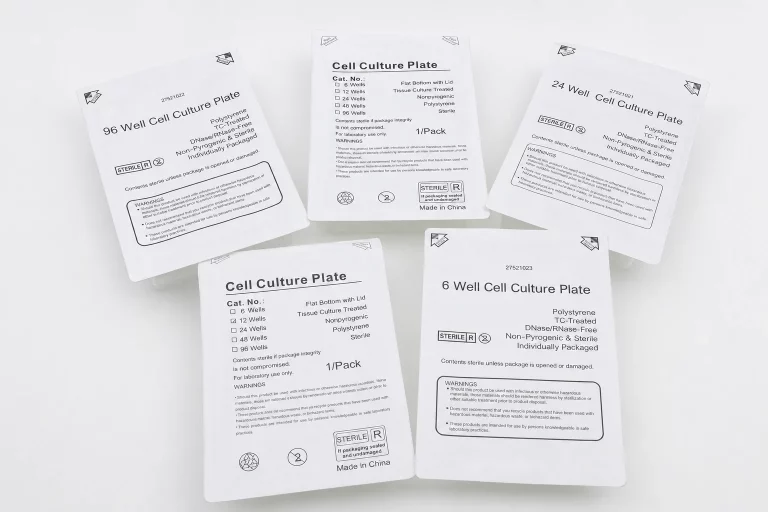
| Primary packaging | Individually wrapped; 1 plate per pack |
| Current case quantity | 50 plates per case |
| Use | Single use; for laboratory research use only |
| Recommended storage | 5-30°C; keep dry and away from direct sunlight |
| Shelf life | 3 years from date of manufacture when stored as directed |
Dimensions and volumes are nominal. Confirm the current technical drawing, dimensional tolerances, packaging configuration and applicable quality documentation with Puretest before placing a production order or validating automated equipment.
Untreated polystyrene is naturally hydrophobic and may not provide reliable attachment for many anchorage-dependent cells. Tissue-culture treatment improves surface hydrophilicity, helping many adherent cells attach, spread and form more consistent monolayers across the plate.
This plate is intended primarily for adherent-cell workflows. Suspension cells, low-attachment models, spheroids and specialized assays may require a non-treated, low-attachment or application-specific surface.
| Application | Why the 96-Well Format Is Suitable |
|---|---|
| Cell viability and cytotoxicity assays | Supports multiple treatments, controls and replicates with low reagent consumption. |
| Compound or drug screening | Enables higher-throughput concentration matrices and parallel sample processing. |
| Transfection screening | Allows comparison of multiple reagents, ratios and nucleic-acid doses on one plate. |
| Media or coating optimization | Reduces material use when comparing many formulations or surface conditions. |
| Cell imaging | Clear flat bottoms support routine microscopy and compatible image-analysis workflows. |
| Plate-reader cell assays | Approximately standard dimensions support compatible absorbance and other validated measurements. |
| Automation and repeat processing | The 8 x 12 layout suits compatible multichannel pipettes and selected liquid-handling platforms. |
The approximately standard microplate footprint is designed for common laboratory workflows, including standard CO2 incubators, compatible inverted microscopes and imaging systems, 8- and 12-channel pipetting, compatible microplate readers, plate shakers and selected automated liquid-handling platforms.
Compatibility depends on the reader optics, carrier, gripper, deck layout, liquid class and software settings. Confirm dimensional and optical requirements using the current product drawing before routine instrument or automated use.
These recommendations are general guidance. Users should follow their validated cell-culture and assay protocols.
The plate is sterilized by gamma irradiation and individually sealed. Depending on the specification and order requirements, quality-control activities may include raw-material and appearance inspection, dimensional checks, well consistency, surface-treatment consistency, packaging-integrity inspection, sterility validation, DNase/RNase testing, pyrogen or endotoxin evaluation and cell-attachment performance assessment.
If your purchasing specification requires a particular Sterility Assurance Level, endotoxin limit, Certificate of Analysis, Certificate of Conformance or other batch document, state the requirement before ordering. Puretest will confirm which limits and documents apply to the quoted product and production lot.
Each sterile plate is individually packaged, with a current standard case quantity of 50 plates. Confirm the quoted inner packing, carton dimensions, gross weight, MOQ and lead time because commercial configurations may vary by order. Export cartons are prepared to help protect plates from compression and packaging damage during transportation.
Orders can be arranged by courier, air or sea according to delivery urgency, destination and volume. Samples can be requested for dimensional fit, cell attachment, imaging and assay evaluation.
Subject to order quantity and technical review, available services may include private-label sterile pouches and cartons, customized labels and barcodes, customer catalog numbers, tailored pack quantities, branded instruction sheets, multilingual packaging, batch documentation and long-term distributor supply planning.
For an OEM proposal, provide the target market, estimated annual volume, packaging language, desired delivery schedule and documentation requirements.
| Format | Relative Culture Area | Reagent Use | Typical Use |
|---|---|---|---|
| 6-well | Largest | Highest | Expansion, coverslips, scraping and higher-yield collection |
| 12-well | Medium-large | Medium | Transfection, staining, optimization and sample preparation |
| 24-well | Medium | Medium-low | Multi-condition assays, microscopy and dose-response studies |
| 48-well | Small | Low | Screening, optimization and replicate-heavy studies |
| 96-well | Smallest | Lowest | Higher-throughput assays, screening, readers and automation |
It provides the highest throughput in this plate family and reduces cell, medium and compound consumption per condition.
Approximately 70-200 µL per well is the recommended range. Optimize the final volume for cell type, assay duration, detection method and evaporation control.
The 8 x 12 layout supports compatible multichannel workflows. Confirm channel spacing, tip position and pipetting parameters before routine use.
The clear flat-bottom design is suitable for compatible plate-reader workflows. Confirm the required optical path, wavelength, plate height and instrument settings.
The TC-treated surface is primarily designed for adherent cells. Suspension or spheroid applications may require a different surface.
Yes. Include the instrument model, carrier requirements, workflow, quantity and destination country with the request.
Applicable batch and quality documents can be provided according to the quoted product and order requirements. Confirm the required list before ordering.
Private-label packaging, labels, barcodes, instruction sheets and carton markings can be discussed for eligible volume orders.
Tell us your cell type, assay, instrument model, annual quantity, destination country and packaging requirements. Contact Puretest for a sample, current technical drawing, applicable quality documentation or commercial quotation.
General Inquiries
Please leave your message here! We willsend detailed technical info and quotationto you!