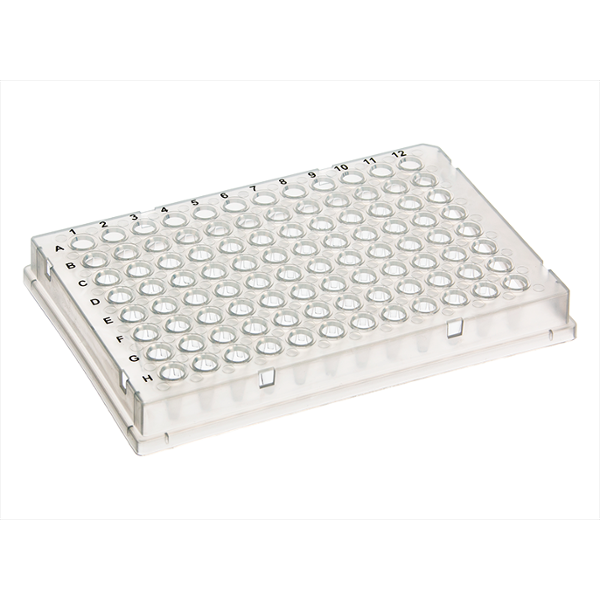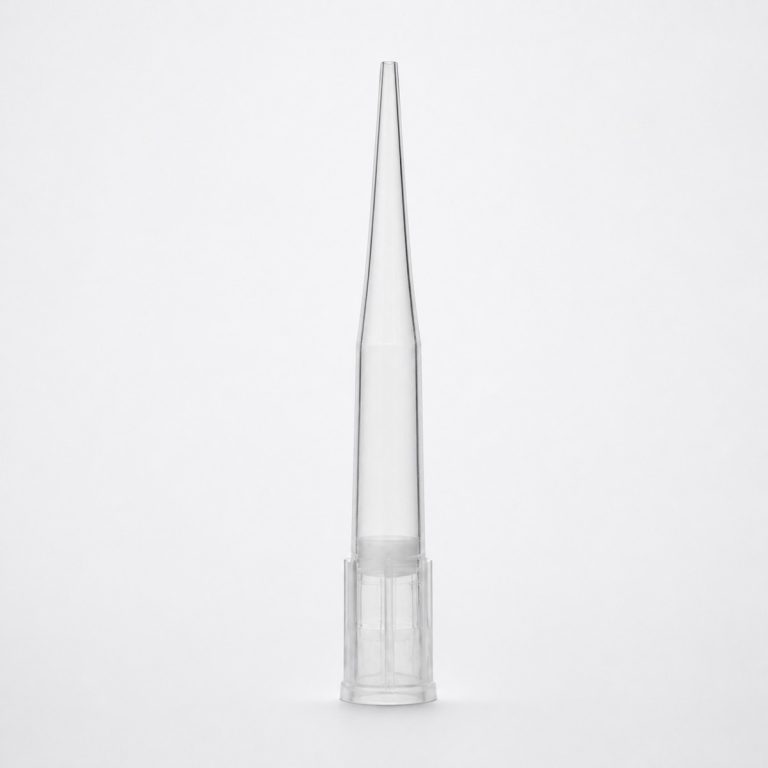
The Puretest 0.1 mL 96-well full-skirted PCR plate combines low-profile reaction wells with a rigid automation-friendly frame. Its Bio-Rad®-type geometry is intended for compatible thermal cyclers and real-time PCR systems after model-specific validation.
Ninety-six thin-wall wells are held in a full perimeter skirt that stabilizes the deck and protects the well array during handling. The low-profile wells reduce the distance between the heated block and reaction mixture, while the full skirt supports repeatable positioning in compatible carriers.
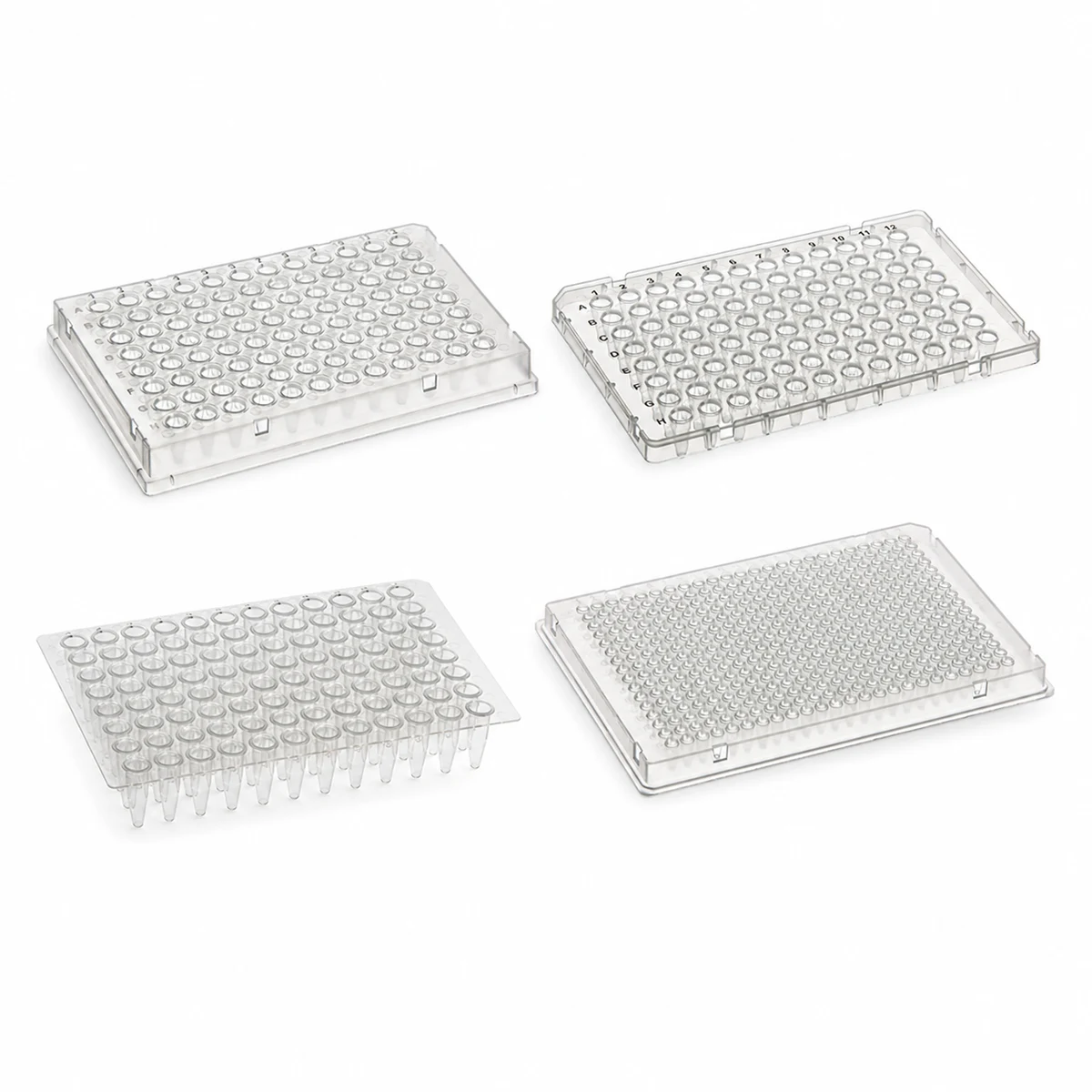
Ninety-six thin-wall wells are held in a full perimeter skirt that stabilizes the deck and protects the well array during handling. The low-profile wells reduce the distance between the heated block and reaction mixture, while the full skirt supports repeatable positioning in compatible carriers.
Use a calibrated thermal cycler and a seal compatible with the optical detection method. Do not force the plate into a block that does not fully support the skirt and well array.
| Plate format | 96 wells; 8 × 12 array |
|---|---|
| Nominal well format | 0.1 mL low profile |
| Typical reaction-volume reference | Approximately 10–100 µL; follow assay and instrument guidance |
| Skirt style | Full skirt |
| Compatibility style | Bio-Rad®-type frame; verify exact instrument |
| Material | High-purity polypropylene (PP) |
| Well wall | Uniform thin wall |
| Pitch | 9 mm nominal |
| Footprint | ANSI/SLAS-style outer footprint |
| Color options | Clear and white subject to quotation |
| Sealing | Optical adhesive film or compatible heat seal |
| Cleanliness | Applicable DNase/RNase, pyrogen and PCR-inhibitor status confirmed for quoted SKU |
Dimensions, working volumes and compatibility are nominal unless stated in the current Puretest drawing. Validate the exact instrument, seal and thermal protocol before routine use.
Designed around a Bio-Rad®-type low-profile full-skirt frame. Confirm the exact thermal cycler, heated lid, corner orientation, plate color and seal. Similar-looking plates may differ in skirt height or block contact.
| Application | Why This Format Is Suitable |
|---|---|
| Standard PCR | Low-profile wells support efficient cycling and consistent endpoint amplification. |
| qPCR / real-time PCR | White-well configurations can improve fluorescence signal control when required. |
| Genotyping | Rigid indexed format supports traceable multi-sample workflows. |
| Automated reaction setup | Full skirt supports plate carriers, grippers and barcodes after validation. |
| Sequencing library preparation | Useful as a downstream amplification plate in validated protocols. |
Puretest laboratory consumables are molded from high-purity polypropylene selected for chemical resistance, low biomolecule binding and dependable dimensional consistency. Available cleanliness, sterile and packaging configurations must be matched to the quoted catalog number.
If your workflow requires a Certificate of Analysis, Certificate of Conformance, irradiation record, DNase/RNase status, pyrogen limit, human-DNA limit, dimensional report or batch traceability, state the requirement before ordering. Puretest will confirm which documents apply to the selected configuration rather than treating every supply option as identical.
Puretest supports evaluation samples, current technical drawings, bulk and individually protected packaging, sterile and non-sterile options, customer catalog numbers, private labels, barcodes and distributor carton programs. MOQ, inner-pack quantity, case quantity, lead time, carton dimensions and shipping method are confirmed with the final specification.
| Plate Format | Well Count | Frame / Orientation | Best-Fit Workflow |
|---|---|---|---|
| 0.1 mL full-skirted | 96 wells | Bio-Rad®-type frame | Rigid low-profile PCR/qPCR workflows |
| 0.1 mL semi-skirted FAST®-type | 96 wells | Low-profile semi skirt | Fast-cycling block formats |
| 0.1 mL semi-skirted LightCycler®-type | 96 wells | Notched semi skirt | Selected LightCycler®-type instruments |
| 0.2 mL non-skirted | 96 wells | Flexible non-skirted frame | Broad routine PCR compatibility |
| 0.2 mL semi-skirted ABI®-type | 96 wells | Raised semi skirt | Selected ABI®-type blocks and automation |
| 0.2 mL semi-skirted straight side | 96 wells | Straight-sided semi skirt | Routine PCR and plate handling |
| 40 µL 384-well one-notch | 384 wells | ABI®-type one-notch frame | High-throughput low-volume PCR/qPCR |
| 40 µL 384-well two-notch | 384 wells | Roche®-type two-notch frame | Selected Roche®-type 384-well systems |
Instrument names describe compatibility style only. Confirm the block format, skirt, corner cut, notch position, optical requirement and current drawing before ordering.
ABI®, Bio-Rad®, FAST®, LightCycler® and Roche® are trademarks of their respective owners. Puretest is not affiliated with or endorsed by those companies. Compatibility-style descriptions help buyers identify frame geometry and do not replace instrument validation.
A full skirt increases rigidity, provides barcode surfaces and supports robotic handling.
No. The name describes compatibility style. Confirm the exact model using the current drawing and a sample.
Clear wells suit many endpoint PCR workflows. White wells are often selected for qPCR signal reflection; follow the instrument and assay requirements.
Use an optical film for fluorescence detection or a validated heat seal for secure closure.
Yes, subject to the selected SKU. Confirm required documents before ordering.
Tell us the required 0.1 mL full-skirted, thermal cycler model, reaction volume, optical color, skirt and corner/notch requirement, annual quantity and destination country. Contact Puretest for a sample, current technical drawing, cleanliness-document confirmation or commercial quotation.