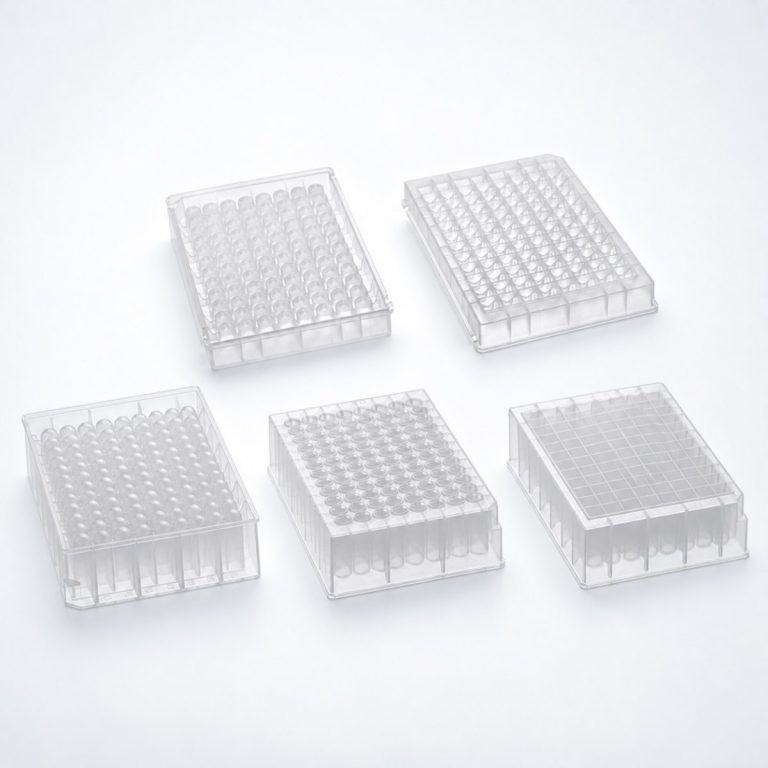

In modern biomedical research, the accuracy of cell culture work directly affects how repeatable the later results turn out. Picking the right multiwell cell culture plates and tissue culture plates is important to avoid edge effects, keep cells healthy, and get good assay sensitivity. As a dedicated laboratory consumables supplier and premier cell culture plate manufacturer, Puretest supplies high-performance cell culture plasticware and laboratory cell culture consumables built to meet strict scientific standards. This guide covers the main selection points, structural details, and application-specific life science laboratory supplies for today’s research work.
Core Structural Variables in Multiwell Cell Culture Plates
Choosing the right format means matching the physical well structures of multiwell cell culture plates with the throughput and imaging needs of your experiment.
Well Configuration & Spatial Optimization
The choice of well density in cell culture plates decides both how much sample you use and the total experimental yield.
- 6-Well & 12-Well Formats: These work well when you need to collect large amounts of cell lysates, RNA, or protein samples from each well.
- 24-Well & 48-Well Formats: They strike a balance between surface area and sample numbers. These multiwell cell culture plates suit cytotoxicity assays and transfection tests.
- 96-Well Formats: The standard 96-well cell culture plate format is used for high-throughput screening (HTS), enzyme-linked immunosorbent assays (ELISA), and automated liquid handling systems.
Surface Treatment: TC-Treated vs. Non-Treated
Surface chemistry decides whether cells can stick, spread, and grow well across tissue culture plates.
- TC-Treated Plates: TC-treated plates are modified to add oxygen-containing groups. This makes the polystyrene surface hydrophilic so adherent cell lines attach firmly.
- Non-Treated Plates: These have a hydrophobic surface that stops adhesion. They work well for suspension cultures and hybridoma work.
Material Specifications and Optical Performance
The quality of the raw materials in cell culture plasticware controls optical clarity during microscopic checks and keeps samples stable over time.

High-Purity Polystyrene & Optical Clarity
Low background interference in tissue culture plates is needed for accurate fluorescent and luminescent readings.
- Class 100K Cleanroom Molding: These are made from medical-grade virgin polystyrene inside ISO13485 and CE-compliant Class 100K cleanrooms to cut auto-fluorescence.
- Flat-Bottom Clarity: Precision-molded flat wells give even optical light paths. This stops distortion during automated microscopy and microplate reading.
Sterility Assurance & Contamination Control
As a trusted sterile culture plate supplier, our strict sterility rules remove outside contamination risks that can disrupt biological processes.
- Sterility Assurance Level (SAL 10⁻⁶): Gamma-sterilized cell culture plates stop bacterial, fungal, and mycoplasma contamination.
- Certified Free of Contaminants: Batches are tested to be non-pyrogenic, DNase-free, RNase-free, and human DNA-free.
- Lid Mechanics & Condensation Rings: Raised well rims and individual lid condensation rings cut evaporation and cross-contamination across all multiwell cell culture plates.
Application Scenarios & High-Performance Puretest Solutions
Matching the right cell culture plates to specific research workflows fixes common problems like poor cell attachment, cross-contamination, and evaporation.
High-Throughput Screening & Microplate Assays
High-throughput screening needs high consistency across all wells without differences in signal detection.

- Target Solution: Puretest 96 Well Cell Culture Plate, Sterile (TC-Treated).
- Product Features: Alphanumeric well labeling, uniform TC-treated flat bottoms, and individual well condensation rings on these TC-treated plates to stop edge-effect evaporation.
- Application & Problem Solved: These are widely used in automated drug discovery and cellular cytotoxicity assays. They fix signal variation by keeping uniform cell monolayer growth across every 96-well cell culture plate.
Anchorage-Dependent Primary & Passaged Cultures
Primary cells and demanding adherent lines need steady, high-affinity surface properties on tissue culture plates for stable attachment.
- Target Solution: Puretest 6-Well Treated Cell Culture Plate, Sterile.
- Product Features: Large growth surface area (9.5 cm² per well), good surface energy modification on TC-treated plates, and serrated side grips for safe handling.
- Application & Problem Solved: These are made for gene expression analysis, Western blotting sample preparation, and stem cell expansion. They stop cell detachment during regular media changes and raise total harvested biomass.
Contamination-Sensitive & Scalable Workflows
Intermediate multiwell platforms need flexible surface space while protecting cultures from airborne contamination.
- Target Solution: Puretest 24-Well Treated Cell Culture Plate, Sterile.
- Product Features: Individual well isolation design, stackable lid geometry, and crystal-clear polystyrene construction for reliable laboratory cell culture consumables.
- Application & Problem Solved: These are often used in transfection studies, viral titration, and co-culture setups. The design reduces well-to-well cross-contamination during manual pipetting and multi-day incubator storage.
Why Partner with Puretest: OEM & Manufacturing Strengths
As a premier cell culture plate manufacturer, trusted sterile culture plate supplier, and global laboratory consumables supplier, Puretest runs over 15,000 square meters of ISO13485 and CE-compliant facilities with Class 100K GMP cleanrooms. We focus on OEM cell culture plates with production setups that include over 100 high-speed, fully electric injection molding machines linked to an advanced Manufacturing Execution System (MES). This allows automated, human-touch-free production of cell culture plasticware. More than 25% of our staff works on R&D. This lets us offer customized mold designs, private labeling, and tailored ODM/OEM services for global life science laboratory supplies brands.

Optimize Your Lab Workflows with Puretest
Whether you are scaling up high-throughput drug screening or looking for a reliable partner for OEM cell culture plates, Puretest offers factory-direct pricing, high-speed automated production, and reliable global delivery. As your trusted laboratory consumables supplier, we deliver premium tissue culture plates and complete laboratory cell culture consumables solutions.
Contact our technical sales team today to request free sample kits or discuss custom ODM/OEM solutions!
- Email: sales@biopuretest.com
- WhatsApp / Phone: +86 151 6712 9685
FAQ
Q: What is the primary difference between TC-treated and non-treated tissue culture plates?
A: TC-treated plates go through a surface modification process that makes the polystyrene hydrophilic. This helps adherent cells attach and spread. Non-treated tissue culture plates keep a hydrophobic surface, which is preferred for suspension cultures where cell adhesion is not wanted.
Q: How do condensation rings on cell culture plate lids help improve experimental consistency?
A: Lids on multiwell cell culture plates with built-in condensation rings sit directly over each well. They guide evaporated media back into the matching well. This cuts well-to-well evaporation, reduces the edge effect, and stops cross-well contamination.
Q: Are Puretest multiwell cell culture plates compatible with automated microplate readers and robotic liquid handlers?
A: Yes. Puretest multiwell cell culture plates and each 96-well cell culture plate are made to standard ANSI/SLAS microplate dimensions. This allows smooth use with standard automated liquid dispensers, plate washers, and optical microplate readers.
Q: Can Puretest provide custom packaging, private labeling, and OEM manufacturing for cell culture consumables?
A: Yes. Puretest is an experienced cell culture plate manufacturer that offers full OEM cell culture plates and ODM services. These include custom mold engineering, private labeling, customized sterile packaging, and automated high-speed production of cell culture plasticware tailored to distributor needs.