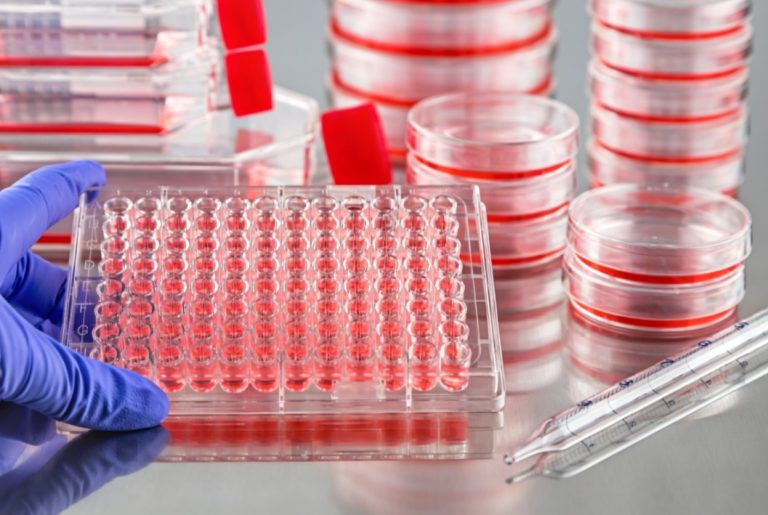
A cell culture plate is a flat plate with multiple wells used to grow and maintain cells in vitro (outside the body). Key features of cell culture plates:
– Made of polystyrene plastic that is treated to promote cell adhesion.
– Come in different sizes such as 6, 12, 24, 48, and 96 well plates to fit different experiment needs.
– Wells can be flat-bottomed or have a rounded/conical bottom.
– Sterile and sold individually wrapped.
– Different surface coatings available (e.g. collagen) to enhance cell attachment.
– Allows for growing and analyzing cells under controlled conditions outside the body.
– Cells can be grown directly in the wells or on coverslips placed in the wells.
– Widely used for cell proliferation, cytotoxicity, drug screening assays, and microscopy.
– Compatible with automated high-throughput equipment and imaging systems.
So in summary, the cell culture plate is a basic laboratory tool used for culturing and studying cells in vitro for research and clinical applications. The multi-well format allows testing multiple conditions in parallel on cells from the same source and passage.