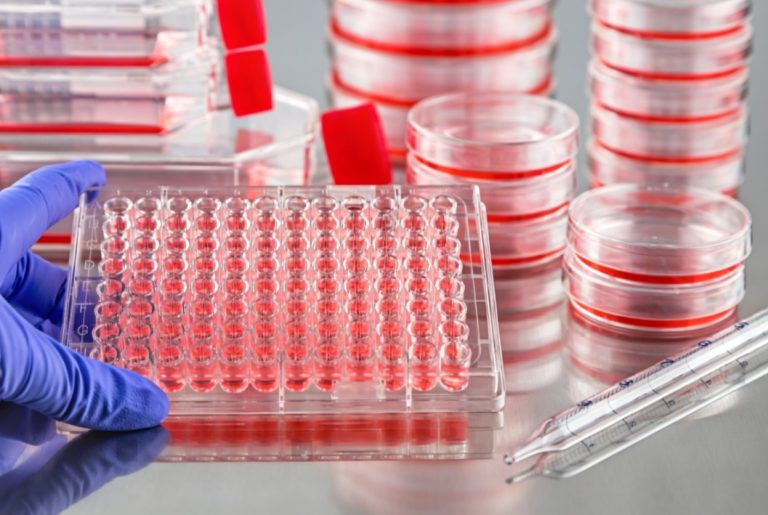

In molecular biology labs, small details often decide the success of a PCR run. Researchers focus mainly on primers and temperatures. Still, the PCR plate matters a lot for the final results. Its design, such as a non-skirted or semi-skirted frame, changes heat flow to the samples. It also impacts evaporation and how well it works with automated equipment.
Puretest produces medical and lab consumables in a facility larger than 15,000 square meters. The facility meets ISO13485 and CE standards. The company relies on Class 100K GMP clean rooms and modern automated lines. This setup creates steady, high-quality PCR plates that lower variation in experiments.
Understanding the “Skirt”: More Than Just an Aesthetic
The skirt on a PCR plate is the plastic border around the outside. It is more than decoration. This feature supports labeling, gives robotic arms something solid to grip, and helps keep the wells stable while the plate goes through temperature cycles.
What Defines a PCR Plate Skirt?
The skirt is the plastic structure along the plate’s perimeter. Different designs offer different levels of support and flexibility.
- Non-Skirted: These plates have no outer plastic frame. The wells connect through a thin lattice, which makes the plate quite flexible.
- Semi-Skirted: These include a short skirt around the edge. The added frame gives more stiffness and provides space for barcodes or handwritten labels, which helps with tracking samples in bigger projects.
Non-Skirted PCR Plates: Maximum Versatility for Manual Workflows
Non-skirted plates work well as the go-to flexible option in many labs. With no stiff outer frame, you can easily cut them down into smaller pieces, like 24 or 48 wells. This approach helps save money when running smaller batches instead of using a complete 96-well plate.

Technical Features and Universal Compatibility
These plates fit directly into most thermal cycler blocks. Since they have no outer skirt, they work with a broad range of standard 96-well thermocyclers from various brands.
Low-Throughput Research and Budget Optimization
Labs use these plates a lot in academic settings and early research projects where full automation is not needed.
- Where it is used: Academic groups and smaller research projects that run varied experiment sizes.
- Problem Solved: They remove compatibility headaches. Many labs still use older thermocyclers that only accept certain plates. Non-skirted versions solve this and fit multiple instruments without trouble.
- Data Insight: Labs that often run smaller batches notice real savings on consumables. Some report cutting costs by up to 30% because they can trim plates to match the exact number of wells they need.
Semi-Skirted PCR Plates: The Standard for Precision and Automation
When labs start processing more samples and bringing in automation, semi-skirted plates become the common choice. The short frame gives robotic arms enough support to pick up and move the plate without bending.
Enhanced Structural Integrity and Robotic Handling
The skirt creates a rim that improves sealing with adhesive films or heat sealers. Strong sealing makes a difference because it cuts down on the edge effect, where outer wells lose liquid through evaporation while the run is going.
High Throughput qPCR & Automated Liquid Handler
- Where it is applied: Diagnosis laboratories, big genomic projects, and wherever there is a use of robotic pipettors.
- Problem it Solves: It prevents bending at high temperatures, for instance, 95°C de-naturing stage. They keep the wells compressed to the block throughout the run since the frame holds them firmly against the block.
- Data Point: Temperature difference in these plates normally lies within ±0.3°C across all wells.

Puretest Solutions: Engineering Excellence for Your Lab
Puretest draws on more than 15 years of experience to make PCR plates that balance strong performance with practical costs.
Puretest 0.2 mL Non-Skirted PCR Plate: The Flexible All-Rounder
Puretest 0.2 mL Non-Skirted PCR Plate uses medical-grade polypropylene that keeps DNA and RNA binding low.
- Feature: Uniform ultra-thin walls.
- Advantage: Heat moves quickly and evenly through the samples, which can shorten overall run times and improve consistency.
- Usage Case: It works well for standard PCR in general thermocyclers where researchers pipette samples by hand.
Puretest 0.1 mL Semi-Skirted (FAST®-Type) Plate: Optimized for Speed
Puretest 0.1 mL Semi-Skirted Plate is built for fast qPCR instruments.
- Feature: Shorter well height of 0.1 mL.
- Advantage: Less air space above the reaction liquid reduces evaporation and improves signal quality in fluorescence detection.
- Usage Case: It performs strongly in FAST qPCR protocols that use small reaction volumes of 5-10 µL. The design helps prevent sample loss in these low-volume setups.
How to Choose: A Practical Decision Matrix
Picking the right plate depends on a few simple questions about your setup.

- Check Your Instrument: Does your thermocycler use high-profile 0.2 mL or low-profile 0.1 mL plates? Some ABI-style systems need specific semi-skirted formats.
- Evaluate Throughput: Robotic systems usually need semi-skirted plates. This helps grippers handle them without damage or misalignment.
- Consider Sealing: Past runs with evaporation problems benefit from semi-skirted plates. The extra frame supports tighter seals with heat sealers or films.
Quality You Can Trust
Puretest checks every batch with dimensional measurements and microbiological tests. All plates leave the factory DNase/RNase-free and pyrogen-free. The production floor runs over 100 high-speed injection molding machines connected to an MES system, so each batch stays consistent.
Ready to improve consistency in your PCR work? Puretest supplies a full range of consumables and can develop custom ODM/OEM designs for labs with special requirements. Our team stands ready to support your projects.
Contact Us Today for a Custom Quote and Free Samples!
- Email: sales@biopuretest.com
- WhatsApp: +86 151 6712 9685
FAQ
Q: Does the color of the PCR plate (Clear vs. White) matter more than the skirt type?
A: For certain applications, color makes a bigger difference in results. White plates reflect fluorescence back to the detector and increase sensitivity in qPCR. Clear plates remain the common choice for standard PCR work.
Q: Can I use a non-skirted plate in an automated liquid handler?
A: It is generally not recommended. Non-skirted plates do not have enough stiffness for robotic grippers and plate carriers. They can bend or shift during pipetting.
Q: Why do some semi-skirted plates have a “cut corner”?
A: The cut corner, often at position A12 or H1, acts as a physical guide. It ensures the plate always sits in the correct orientation inside the thermocycler or robot and prevents accidental 180-degree flips.
Q: Is there a significant difference in evaporation between 0.1 mL and 0.2 mL plates?
A: Yes, especially in small reaction volumes. The 0.1 mL low-profile plates have less headspace above the liquid. This smaller air volume reduces evaporation during heating cycles.